
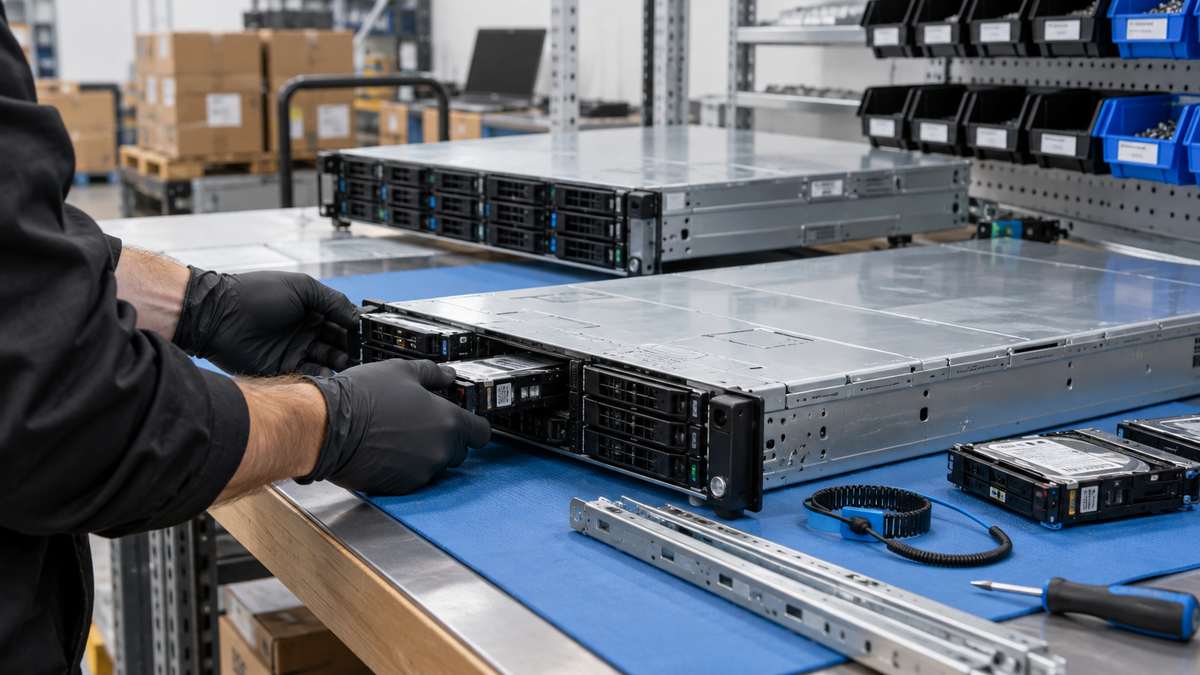
Buying used rack servers is not the same as buying a loose component. A server is a platform: chassis, motherboard, CPU, memory, storage, power, firmware, rails, remote management, and packaging all have to work together. When one detail is missed, a good price can turn into a deployment delay.
This guide is for IT teams, resellers, labs, system integrators, and business buyers who need dependable used rack servers in quantity. The goal is simple: help you ask better questions before the quote, so the hardware that arrives is closer to the hardware you expected.
Start with the workload, not the model number
A model name is only the beginning. The same 1U or 2U rack server family can ship with different processor generations, memory types, drive backplanes, RAID options, network cards, risers, power supplies, and management licenses.
Before you ask for pricing, write down what the servers need to do. A virtualization cluster may care about memory capacity and redundant networking. A storage node may depend on drive bay count, HBA mode, and airflow. A GPU or AI support server may need PCIe slot layout, power budget, and validated riser configuration. If you are still shaping the request, TBR's server and data center hardware sourcing page is a useful place to frame the project.
Check generation, CPU, and memory compatibility
Generation matters because it affects firmware support, memory type, PCIe generation, management features, and the practical life of the system. A used rack server can still be a strong fit, but buyers should know whether they are standardizing around a platform they already operate or introducing a new platform into the environment.
For CPUs, confirm the exact processor model, socket generation, core count, base power, and whether the server is configured as single-socket or dual-socket. For memory, confirm the type, speed, capacity, rank mix, and whether modules are installed in a balanced population. If memory is a major part of the order, compare the server configuration against TBR's used server memory buying guide.
Look closely at drive bays, controllers, and boot media
Drive layout is one of the easiest places for a server quote to become confusing. Ask whether the chassis is LFF or SFF, how many bays are active, which trays or caddies are included, and whether the backplane supports the drives you plan to install. If the system includes storage, request health data and ask how data-bearing media was handled.
Controller details matter too. Some buyers need hardware RAID. Others prefer an HBA or pass-through configuration for software-defined storage. If you are ordering used enterprise SSDs separately, review TBR's enterprise SSD buying checklist so the drive health and interface details are clear before shipment.
Do not ignore firmware and remote management
Firmware is not glamorous, but it can decide how smoothly the deployment goes. Dell's PowerEdge guidance points buyers toward updating key server components through supported tools such as iDRAC and Lifecycle Controller, while HPE documents Service Pack for ProLiant as a method for updating firmware, drivers, and system software across ProLiant infrastructure. In practical buying terms, that means a tested server should be described beyond the front bezel: BIOS, BMC or iDRAC/iLO access, storage controller state, NICs, and any hardware alerts should be checked where possible.
Ask whether remote management has been reset, whether default credentials are removed or documented for handoff, and whether the server boots cleanly into setup or a diagnostic environment. For mixed lots, request the variance up front: it is better to know that some systems have a different NIC, riser, or power supply before your team starts racking them.
Plan data handling before equipment changes hands
Used rack servers often include drive bays, SSDs, HDDs, NVMe devices, boot media, or controller cache modules. NIST SP 800-88 Revision 2 defines media sanitization as a process that makes access to target data infeasible for a given level of effort, and it emphasizes verification and documentation as part of a sanitization program. If storage is included, the buyer and seller should agree on the expected handling before the order is finalized.
For some projects, buyers want drives removed. For others, they want tested drives with health data. Some environments require sanitization records before reuse. TBR covers the broader data and disposition side on its data sanitization and physical destruction page and its IT asset disposition services page.
Expect real testing, clear grading, and careful packaging
A used rack server should be checked as a system, not just counted as inventory. Reasonable expectations include visual inspection, power-on testing, hardware inventory review, memory recognition, storage bay checks, management controller access where applicable, fan and power supply checks, and note-taking on cosmetic condition.
Packaging matters because servers are heavy, dense, and vulnerable at the ears, bezels, caddies, rails, and rear ports. For electronics handling, ANSI/ESD S20.20-2021 is a recognized standard for creating an electrostatic discharge control program for electronic parts, assemblies, and equipment. For a buyer, the practical takeaway is to ask about anti-static handling, padding, carton strength, palletization for quantity orders, and whether rails, bezels, and accessories are secured separately. TBR's warranty, testing, and returns page and shipping logistics page explain the expectations around tested hardware and fulfillment.
Ask these questions before requesting a quote
- What exact server model and generation do you need?
- How many units are required, and can substitutions be accepted?
- Do you need 1U, 2U, tower, or blade-style equipment?
- Which CPUs, memory capacity, and storage bay layout are required?
- Should drives be included, removed, sanitized, or quoted separately?
- Do you need RAID, HBA, NVMe, 10GbE, 25GbE, or specific PCIe risers?
- Are rails, bezels, power cords, caddies, and management licenses required?
- What testing, condition grade, packing method, and delivery timeline do you expect?
If you already have a bill of materials or a target configuration, send it through TBR's hardware quote request page. If you are flexible on brand or generation, mention which requirements are fixed and which can be optimized for availability and price.
FAQ
Are used rack servers reliable enough for business use?
They can be, when the configuration is appropriate and the supplier tests and grades them carefully. The key is to avoid vague listings. Ask for the exact configuration, included accessories, test expectations, condition notes, and warranty terms.
Should I buy complete servers or source parts separately?
Complete servers are usually easier when you need repeatable deployments. Parts sourcing can make sense when you already own compatible chassis or need to extend an existing fleet. TBR supports both complete systems and bulk computer parts requests.
What is the most common mistake in used server buying?
The most common mistake is assuming one model number describes the whole system. Drive bays, backplanes, risers, NICs, power supplies, memory population, firmware state, rails, and caddies can vary widely inside the same server family.
Can TBR source servers for international buyers?
Yes. TBR works with business buyers that need careful packaging and shipping support. For international orders, include destination country, quantity, timeline, and any import documentation requirements in the quote request.
Source Notes
- NIST SP 800-88 Revision 2, Guidelines for Media Sanitization, for current media sanitization program concepts, verification, and documentation.
- ENERGY STAR Enterprise Servers and ENERGY STAR Computer Servers Version 4.0, for server energy-efficiency criteria including efficient power supplies, power management, and active/idle energy considerations.
- Dell PowerEdge firmware update guidance, for the importance of supported firmware update workflows across server components.
- HPE Service Pack for ProLiant Quick Start Guide, for HPE's documented firmware, driver, and system software update workflow.
- ANSI/ESD S20.20-2021, for ESD control program requirements for protecting electronic parts, assemblies, and equipment.