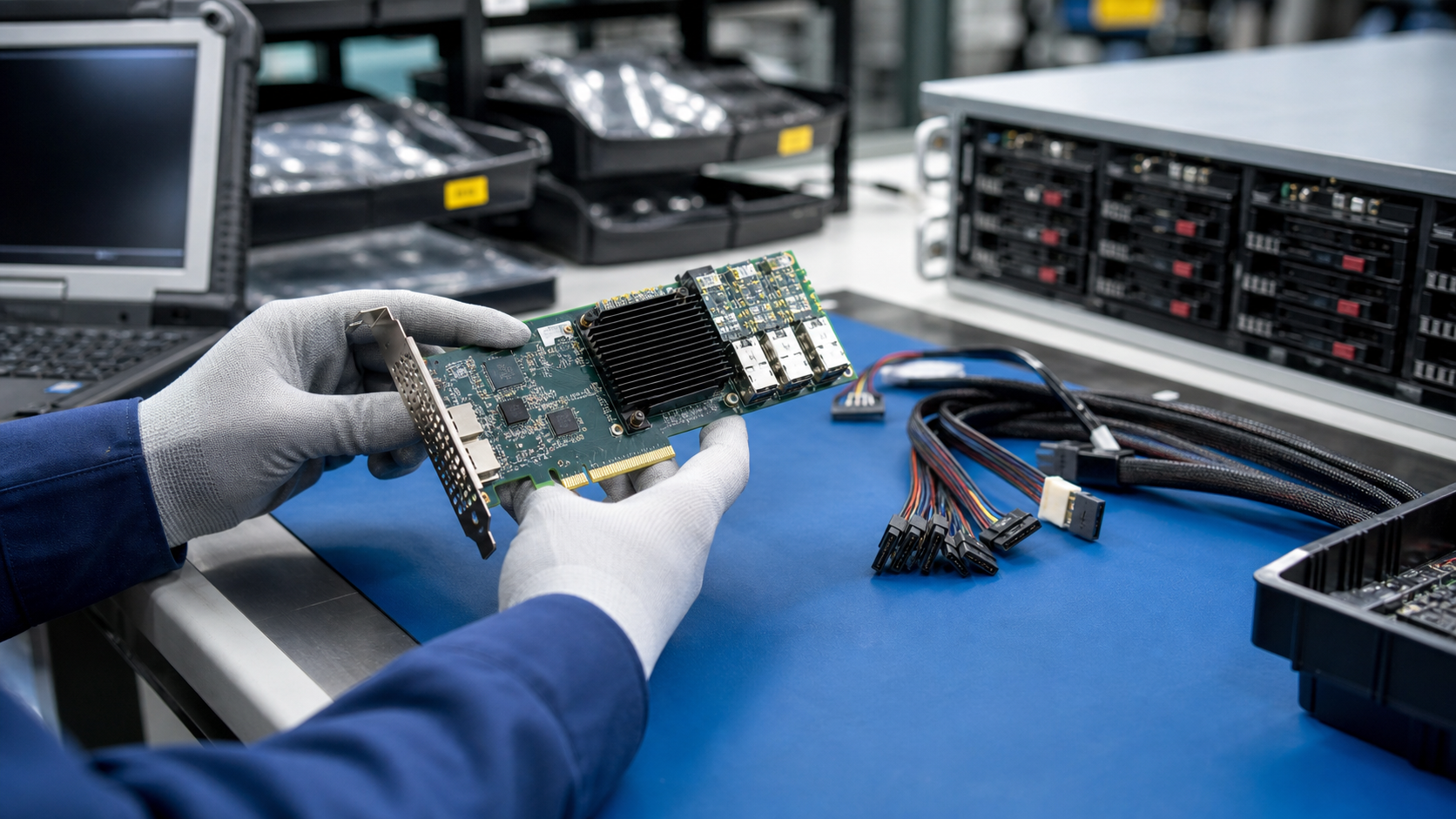
Storage controller purchases look simple until the shipment reaches the bench. Two cards can share the same connector style and still behave very differently once they meet a server backplane, firmware policy, operating system, driver stack, disk shelf, or storage workload. That is why used RAID controllers and HBAs should be sourced with the same discipline buyers already apply to CPUs, memory, SSDs, GPUs, and server platforms.
TBR Trade Group helps buyers source broader server and data center hardware, and storage adapter requests are strongest when they include the server model, existing controller, drive type, backplane, cable needs, operating system, firmware preference, quantity, destination, and acceptable alternatives. The goal is not just to find a card. The goal is to find the card that can actually run in the target environment.
RAID Controller or HBA: Start With the Job
A RAID controller and a host bus adapter are not interchangeable procurement labels. A RAID controller typically manages disk arrays through the controller and may use cache, battery backup, or flash-backed protection depending on the model. An HBA is usually selected when the operating system or storage software needs more direct visibility into the attached drives. Some buyers also need pass-through, JBOD, or a specific firmware mode.
Before comparing prices, decide how the storage will be managed. A virtualization host, backup server, NAS appliance, database node, video storage system, lab chassis, and replacement repair part can all point to different controller requirements. If the project is part of a larger component order, connect the storage-card request to bulk computer parts planning so cables, drive trays, SSDs, memory, CPUs, and spare cards are quoted together instead of piecemeal.
- Define whether the target design needs hardware RAID, pass-through, JBOD, or HBA behavior.
- Confirm the server, motherboard, riser, PCIe slot, backplane, drive type, and operating system.
- Ask for the exact controller model, port layout, bracket type, firmware mode, and included cables.
- Separate must-have part numbers from acceptable equivalents before asking for volume pricing.
Match the Interface, Not Just the Connector
Connectors can be misleading. Buyers need to confirm the full storage path: controller, cable, backplane, drive interface, drive form factor, firmware, driver, and server platform. SAS, SATA, and NVMe are different storage paths. Some modern tri-mode adapters support more than one interface family, but that does not mean every cable, backplane, or server will support every drive type.
NVM Express explains that NVMe specifications define how host software communicates with non-volatile memory across transports such as PCIe, RDMA, TCP, and more, and it describes NVMe as an industry standard for SSDs in form factors such as U.2, M.2, AIC, and EDSFF. For buyers, the practical takeaway is direct: NVMe support is a controller, cable, backplane, and platform question, not just a drive label question.
If the storage project includes drives, pair this controller checklist with TBR's used enterprise SSD buying checklist. Drive health, interface, endurance, sanitization status, and packaging should be checked at the same time as controller fit.
Firmware and Driver Support Are Part of the Quote
Used storage adapters can arrive with different firmware versions, RAID policies, initialization states, vendor personalities, or mode settings. That may be acceptable for a lab, but it can slow down a production repair. Buyers should ask what firmware state is expected, whether the controller has been reset, whether old array metadata was cleared, and whether the target operating system has known driver support for that model.
For replacement cards, match the current controller as closely as the server vendor requires. For upgrades, confirm whether the server BIOS, management controller, operating system, and monitoring stack support the card. For storage software that expects direct drive access, specify that requirement up front and do not assume a controller can be converted after it arrives.
- Ask whether the card is tested in RAID mode, HBA mode, IT mode, JBOD mode, or another specific profile.
- Confirm whether firmware is current, reset, or intentionally left at a customer-requested version.
- Verify driver support for the operating system before approving a substitute model.
- Document whether old array configuration data should be cleared before shipment.
Cache Protection and Accessories Matter
The controller card is only one part of the storage path. Cache modules, battery backup units, supercapacitors, flash cache protection, cables, brackets, airflow baffles, risers, and drive trays can decide whether the purchase works. A bare card may be a good value when the buyer already has the accessories. It can be a delay when the buyer needs a complete kit.
Cache protection deserves special attention. An aged battery, missing cache module, incompatible cable, or low-profile bracket in a full-height slot can create follow-up sourcing work. Buyers should also confirm whether any battery or capacitor module is allowed and practical to ship to the destination, especially for international orders and urgent replacements.
When condition language is unclear, use TBR's hardware condition guide as a framework. For storage adapters, cosmetic wear is usually less important than connector condition, PCB integrity, bracket alignment, heatsink attachment, firmware state, accessory completeness, and test evidence.
Ask What Testing Actually Covers
"Tested" should be specific. For storage controllers and HBAs, buyers should ask whether the card powers on, is recognized by a compatible host, identifies correctly, detects attached drives, negotiates expected link behavior, passes basic I/O checks, and shows no obvious thermal, fan, bracket, port, or connector issues. The test scope should match the risk of the order.
A replacement card for a production server needs a tighter standard than a mixed repair lot. A batch for resale may need serial tracking, part-number sorting, and visual grading. A deployment order may need matching firmware expectations and known cable kits. TBR's warranty, testing, and returns page is a useful internal reference for documenting pass/fail expectations before shipment.
- Confirm part number, revision, bracket type, port type, firmware mode, and accessory list.
- Ask whether the card was tested in a compatible server or workstation with attached drives.
- Inspect ports, heatsinks, edge contacts, brackets, jumpers, labels, cache modules, and cable latches.
- Clarify replacement terms for dead-on-arrival, incorrect firmware, missing accessories, or port failure.
Storage Sanitization Still Belongs in the Conversation
A storage controller is not the same thing as a used drive, but controller orders often travel with SSDs, hard drives, cache modules, old configurations, or storage shelves. Buyers should separate two questions: is the controller reset and ready for the target environment, and are any included storage media sanitized according to the organization's policy?
NIST SP 800-88 Revision 2, published in September 2025, describes media sanitization as a process that renders access to target data infeasible for a given level of effort. If a controller order includes drives, boot media, cache devices, or storage shelves, ask how previous data and array metadata are handled. For sensitive environments, this question should be answered before hardware leaves the supplier.
That same discipline applies when a company is selling retired hardware back into the market. TBR's IT asset recovery service can help buyers think through reuse value, data-bearing devices, condition, and responsible disposition.
Packaging Should Protect the PCB and Ports
Storage adapters are easy to damage if they are packed like generic scrap parts. Brackets can bend, edge contacts can scrape, connectors can crack, cache modules can detach, and surface components can be knocked loose by heavier hardware. Controllers and HBAs should be protected in anti-static packaging, separated from heavy items, supported so the PCB cannot flex, and boxed with enough cushioning for parcel or freight movement.
The EOS/ESD Association publishes electrostatic discharge standards and guidance for electronics environments, including areas such as packaging, grounding, work surfaces, and control programs. TBR's ESD-safe computer component packaging checklist goes deeper on anti-static handling, cushioning, labeling, and receiving-ready shipments.
Used Storage Controllers Can Extend Useful Server Life
A tested used HBA or RAID card can be the part that keeps a storage server, backup target, lab chassis, or workstation archive running without forcing a full refresh. That is useful when the server platform still fits the workload and the buyer can verify compatibility, firmware, support, and receiving expectations.
EPA electronics guidance notes that donation and recycling help conserve resources and natural materials, and it advises considering hardware or software upgrades before buying a brand-new product. In practical procurement terms, storage-card reuse is worthwhile when the component keeps a good system productive without creating hidden support risk.
If the existing platform is unsupported, short on PCIe lanes, thermally constrained, or incompatible with the drive roadmap, a broader refresh may be smarter. TBR's used enterprise hardware sourcing page can help frame that decision around the full server, not only the controller card.
Used RAID Controller and HBA Buying Checklist
Before approving a used storage controller order, confirm these details with the supplier:
- Target server, motherboard, riser, PCIe slot, operating system, and backplane are documented.
- RAID, HBA, pass-through, JBOD, firmware mode, and driver requirements are clear.
- SAS, SATA, NVMe, U.2, U.3, M.2, AIC, or external shelf requirements have been checked end to end.
- Port type, cable type, cable direction, bracket height, cache module, and accessory list are specified.
- Testing includes host recognition, attached-drive detection, basic I/O behavior, port inspection, and thermal review.
- Condition standards cover PCB, edge contacts, connectors, heatsink, bracket, cache module, and labels.
- Packaging uses ESD-safe protection, connector support, separation from heavy parts, and clear part-number labeling.
- Replacement, return, and receiving timelines are agreed before shipment.
If you are sourcing tested RAID cards, HBAs, SSDs, drive trays, server memory, CPUs, GPUs, or mixed enterprise components, include model numbers, quantities, target platform, condition expectations, acceptable substitutions, and destination when you request a quote from TBR Trade Group.
FAQ
Is a used RAID controller safe to buy?
It can be when the card is compatible with the target server, firmware expectations are clear, accessories are included or intentionally excluded, the card is tested with attached drives, and replacement terms are documented before shipment.
Can I use an HBA instead of a RAID card?
Only if the storage design supports it. Some operating systems and storage stacks prefer direct disk visibility through an HBA, while other environments require hardware RAID behavior. Confirm the software, backplane, cables, and boot requirements before substituting.
Do I need cables with a used storage controller?
Usually yes, unless the server already has the right cable path. Confirm internal or external ports, cable connector type, cable length, right-angle or straight orientation, backplane support, and whether cables are included in the quote.
What should I send for a storage controller quote?
Send the target server model, current controller if replacing one, desired controller model, drive types, backplane details, cable requirements, firmware mode, operating system, quantity, destination, and whether cache modules or brackets are required.
Source Notes
- NVM Express, Specifications: NVM Express explains NVMe communication across transports such as PCIe, RDMA, and TCP, and notes NVMe SSD form factors including U.2, M.2, AIC, and EDSFF.
- Broadcom, MegaRAID 9560-8i: Broadcom's product page identifies this controller class as PCIe Gen 4.0 for SAS/SATA/NVMe storage, illustrating why exact adapter capabilities matter.
- Broadcom, HBA 9500-8i Tri-Mode Storage Adapter: Broadcom's HBA product page is a useful reference point for tri-mode adapter terminology and model-specific planning.
- NIST SP 800-88 Rev. 2, Guidelines for Media Sanitization: NIST published the final Revision 2 in September 2025 and defines media sanitization around making access to target data infeasible for a given level of effort.
- EOS/ESD Association, Standards: The association publishes electrostatic discharge control standards and guidance relevant to safe handling and packaging of sensitive electronics.
- U.S. EPA, Electronics Donation and Recycling: EPA notes that electronics donation and recycling conserve resources and advises considering hardware or software upgrades before buying new electronics.