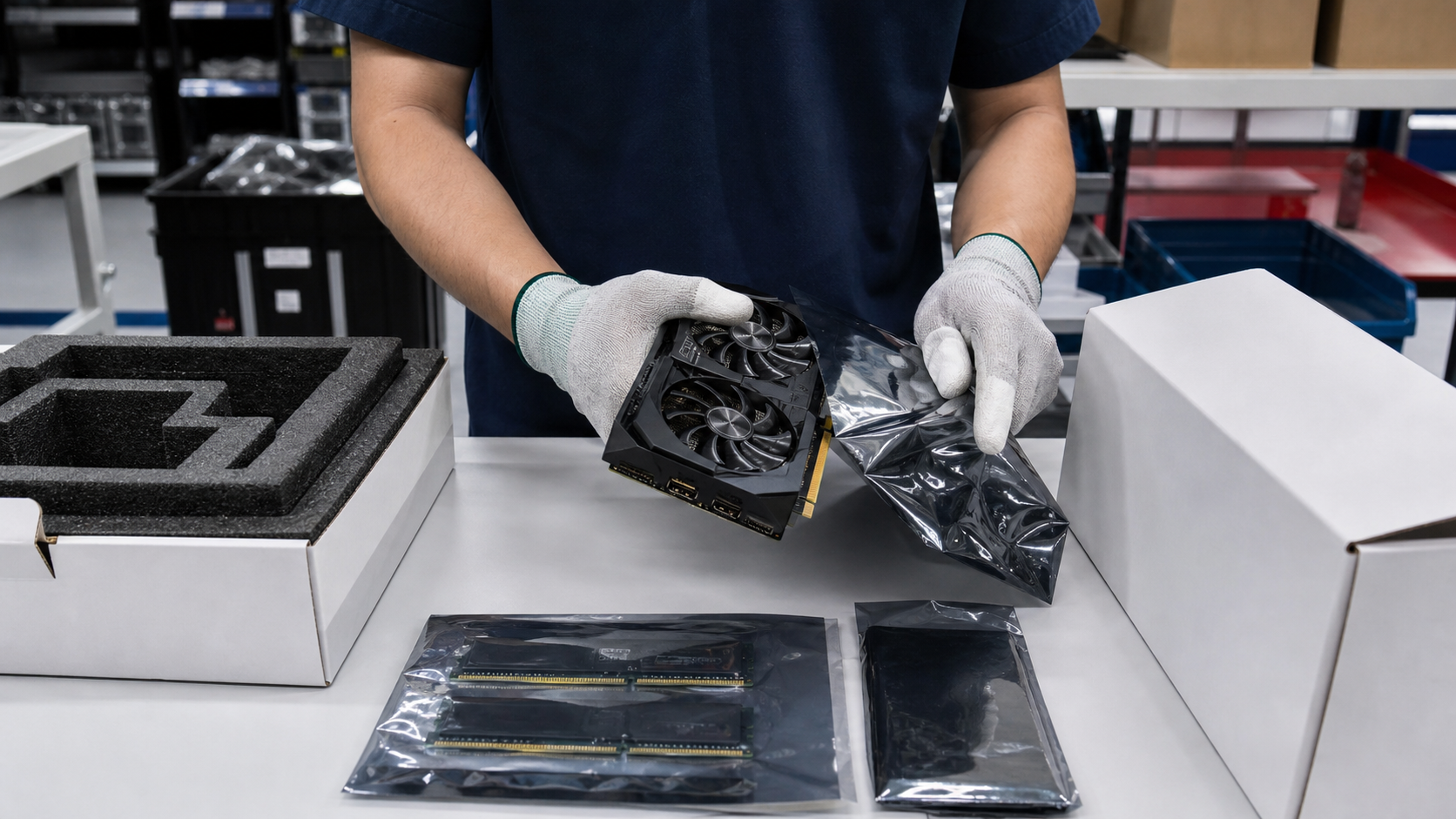
Business electronics buyers often ask smart questions about model numbers, condition, test results, lead time, and price. Packaging deserves the same attention. A component can pass inspection, stress testing, and visual review, then still arrive with a cracked bracket, bent pins, crushed corners, or latent ESD damage if it is packed like an ordinary office supply.
That risk is higher in bulk electronics sourcing because orders may include mixed SKUs: GPUs, RAM, SSDs, network cards, power supplies, server parts, and accessories moving through the same shipment. A good supplier should separate, shield, cushion, document, and label those items before they leave the facility. For buyers sourcing from TBR Trade Group, the same thinking behind our GPU testing process should carry through to the final box.
Start With ESD Control, Not Bubble Wrap
Electrostatic discharge is a handling problem before it is a shipping problem. The ESD Association notes that discharge can happen during manufacturing, testing, shipping, handling, field service, and normal operations, and that sensitive items should be packaged, stored, or transported in materials that reduce charge generation and provide discharge shielding.
For buyers, that means the first question is not "Is the box sturdy?" It is "How was the component protected before it entered the box?" GPUs, DIMMs, SSDs, PCIe cards, and system boards should be handled in an ESD-aware work area, then placed into appropriate shielding or static-control packaging before filler, paper, or outer cartons are introduced.
- Ask whether loose cards are bagged individually in anti-static or static-shielding bags.
- Confirm that exposed contacts are protected from direct contact with cardboard, loose plastic, or other high-charging materials.
- For RAM and small boards, look for rigid trays, sleeves, or inner cartons that prevent flexing.
- For heavier cards, ask how brackets, fans, shrouds, and power connectors are immobilized.
Match the Packaging to the Component
There is no single correct package for every computer part. A boxed workstation GPU, a bare server DIMM kit, and a tray of SSDs need different protection. Professional packaging starts by asking what can actually fail in transit.
GPUs and PCIe cards
Graphics cards need ESD shielding, edge protection, and enough cushioning to prevent the card from shifting inside the box. The cooler, fans, display bracket, PCIe edge connector, and auxiliary power sockets should not be load-bearing points. For enterprise or bulk GPU orders, individually protected units also make receiving easier because each item can be checked against the packing list without exposing the rest of the shipment.
Memory, SSDs, and small boards
Smaller components are easy to underpack because they seem light. The risk is flex, pressure, or contact contamination. DIMMs should not be loose in a bag where gold contacts can rub against other parts. SSDs and adapters should be separated so labels, connector edges, and serial numbers stay readable at receiving.
Server components and heavier hardware
Server parts may need foam spacing, double-wall cartons, palletization, or separate inner boxes depending on quantity and weight. Buyers planning larger projects can pair component sourcing with the same logistics thinking used for server and data center hardware: count the units, understand the destination dock, and define how receiving teams will inspect the order.
Use Cushioning to Immobilize, Not Just Fill Space
Filler is not protection if the component can still move. ISTA describes its 3-Series tests as general simulations of the motions, forces, conditions, and sequences found in transport environments, and its Procedure 3A is designed for individual packaged products shipped through parcel delivery systems up to 150 lb. The practical buyer takeaway is simple: shipping creates vibration, drops, compression, and repeated handling. Packaging should be built for motion.
A professional component shipment usually has three layers of defense: the ESD-safe inner package, fitted cushioning or foam that holds the item in place, and an outer carton sized for the order. For fragile or high-value parts, a box-in-box approach can help keep the inner component package away from corner impacts.
- Good: each component shielded, cushioned, separated, and unable to slide.
- Risky: mixed components loose in one bag, with filler placed only around the outside.
- Good: heavier parts boxed separately or placed at the bottom with crush-resistant spacing.
- Risky: heavy power supplies or coolers sharing a void with exposed cards or DIMMs.
Documentation Should Travel With the Order
Safe shipping is not just physical. A receiving team should be able to reconcile the order without guesswork. That matters for corporate IT, labs, resellers, repair teams, and facilities buying replacement stock from a refurbished GPU supplier or broader electronics source.
At minimum, ask for a packing list that includes model numbers, quantities, condition notes, accessories, and serial or asset identifiers where applicable. For tested parts, include the test status or acceptance criteria. For multi-box shipments, carton labels should make it clear which box contains which units, especially when partial receiving is possible.
Good documentation reduces receiving delays, warranty confusion, and unnecessary returns. It also protects both sides if a carrier claim or shortage review is needed.
International and Bulk Orders Need Extra Planning
When electronics move across regions or through multiple carrier handoffs, packaging and paperwork become part of the buying decision. Buyers should share the destination country, dock restrictions, required commercial documents, preferred carrier, delivery window, and any internal labeling rules before the quote is finalized.
TBR Trade Group's shipping policy is the right place to review carrier, delivery, and handling expectations before ordering. For larger lots, it is also worth asking whether the order should ship as parcel cartons, consolidated cartons, or a palletized shipment. The cheapest service is not always the lowest-cost option if it increases inspection time or damage risk.
Packaging Is Part of Sustainable Reuse
Better packaging also supports responsible electronics reuse. The EPA notes that electronic products contain valuable materials, including metals, plastics, and glass, and that donation or recycling helps conserve resources and reduce pollution. The Global E-waste Monitor 2024 estimated that 62 million tonnes of e-waste were generated in 2022, with documented collection and recycling covering less than one quarter of that mass.
The best reuse outcome is not simply selling a pre-owned component. It is keeping a tested component working in another business environment. When parts arrive intact, buyers can deploy them instead of returning them, scrapping them, or buying new replacements. Packaging is therefore a small operational detail with a real circular-economy effect.
If your organization is retiring hardware as well as buying replacements, pair component sourcing with a plan for secure disposition. TBR's secure e-waste disposal guidance can help separate reusable equipment from material that needs certified recycling or data-sensitive handling.
A Practical Buyer Checklist
Before approving a bulk computer component order, ask your supplier these questions:
- Are ESD-sensitive items handled and packed before ordinary shipping filler is added?
- Are GPUs, memory, storage, and boards individually shielded or separated?
- Can the component move inside the inner package or outer carton?
- Are heavy items separated from delicate cards, fan shrouds, pins, and connectors?
- Does the packing list match model, quantity, condition, and test status?
- Are carton labels clear enough for your receiving team?
- Is the selected shipping method appropriate for the value, quantity, and destination?
For buyers sourcing from a GPU wholesale supplier or mixed electronics partner, these questions are not micromanagement. They are how you protect uptime, receiving labor, budget, and the useful life of the hardware you just bought.
FAQ
Why does ESD-safe packaging matter for tested computer components?
Because the component has already been handled, tested, and prepared for resale. ESD-safe packaging protects that tested condition through storage and transit.
Are original retail boxes enough?
Sometimes they help, but they are not enough by themselves. A supplier still needs ESD shielding, secure immobilization, and proper carton protection for the route.
What should buyers ask for on high-value GPU shipments?
Ask for individual protection, model and quantity documentation, test status, carrier and tracking details, insurance or claim expectations, and clear instructions for receiving inspection.
Source Notes
- EOS/ESD Association, Principles of ESD Control: ESD risks can occur during shipping and handling, and sensitive items should be protected with appropriate packaging and discharge shielding.
- International Safe Transit Association, Test Procedures: ISTA 3-Series procedures simulate transport motions, forces, conditions, and sequences; Procedure 3A applies to parcel delivery shipments up to 150 lb.
- U.S. EPA, Electronics Donation and Recycling: Electronics contain valuable materials, and safe donation or recycling helps conserve resources and avoid pollution.
- Global E-waste Monitor 2024: The report estimates 62 million tonnes of e-waste were produced globally in 2022 and less than one quarter was documented as collected and recycled.