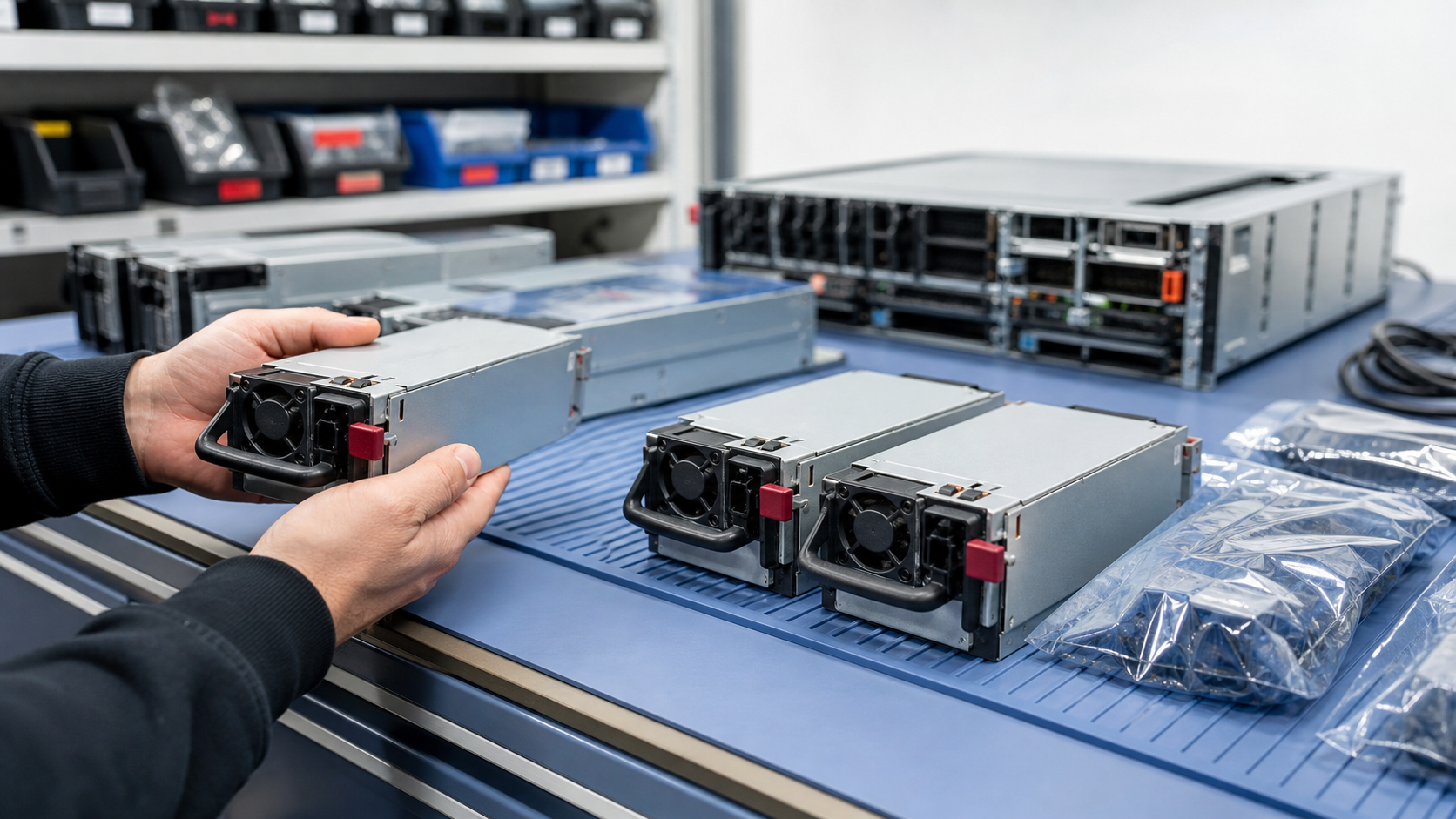
Power supplies are easy to under-spec because they sit behind the more visible parts of a server order: CPUs, memory, SSDs, RAID cards, network adapters, and GPUs. But for repair work, refresh projects, lab builds, and reseller inventory, the PSU can decide whether a system boots cleanly, runs redundantly, and ships without avoidable follow-up.
TBR Trade Group helps buyers source broader server and data center hardware, and power-supply requests are strongest when they include the exact server model, existing PSU part number, target wattage, quantity, destination, redundancy requirement, condition expectations, and acceptable substitutions. A replacement PSU should be treated as a compatibility item, not a generic commodity.
Start With the Server, Not the Wattage
Wattage matters, but it is not the whole purchase. A 750W, 1100W, 1600W, or 2400W module may still be wrong if the chassis generation, vendor part number, input-voltage range, connector shape, firmware behavior, or handle style does not match the target platform. Buyers should confirm the server family, service tag or configuration, current PSU label, and whether the system uses one supply, redundant pairs, or a higher-density power shelf.
If the PSU is part of a mixed component order, connect it to the whole bill of materials. A platform with higher-core CPUs, more memory, accelerators, NVMe storage, or dense network cards can have different power and thermal needs than the base chassis. TBR's bulk computer parts page is a practical place to frame those combined requests instead of quoting one spare at a time.
- Confirm the exact server model, chassis generation, and existing PSU part number.
- Separate mandatory matches from acceptable alternates before asking for pricing.
- Document required wattage, input voltage, efficiency class, handle style, and airflow path.
- State whether you need one replacement, redundant matched pairs, or quantity spares.
Redundancy Requires Matched Planning
Redundant power is useful only when the server and power chain are planned correctly. Many platforms expect matching supplies, supported wattage combinations, compatible firmware behavior, and an adequate input source. Do not assume that a mixed pair will share load correctly, silence alerts, or keep the platform within support expectations.
Ask whether the quote is for an exact replacement, a compatible alternate, or a mixed-lot pull. For production repairs, exact part-number matching is usually the cleanest path. For lab or resale inventory, compatible alternates may be fine when the buyer can test and sort them. The important point is that the quote says which case applies.
- Request matched part numbers when the PSU will operate in a redundant pair.
- Confirm whether the server supports the target wattage in the installed configuration.
- Check whether high-wattage modules require higher-voltage input at the destination.
- Clarify whether power cables, blanks, or retaining hardware are included.
Efficiency and Power Management Affect Operating Cost
For one repair part, buyers often focus on immediate fit. For quantity sourcing, power efficiency and platform behavior deserve more attention. ENERGY STAR notes that certified enterprise servers use more efficient components, including power supplies, and ramp down energy use at lower workloads. Its server product criteria also require more efficient power supplies, advanced power management, real-time performance measurement, and lower active and idle energy use.
That does not mean every buyer needs the newest PSU. It does mean a sourcing request should not treat wattage as the only performance label. If efficiency rating, data center power planning, heat load, or electricity cost matters, ask for the PSU efficiency class and server compatibility at the quote stage. When a used PSU is being used to extend the life of an existing fleet, compare the replacement cost against power draw, workload value, and the timing of the next server refresh.
Power planning also extends outside the chassis. ENERGY STAR's UPS guidance says UPS selection depends on the equipment being protected, the number and size of those devices, required features, and the needed uptime window. For buyers, the practical takeaway is simple: server PSUs, rack PDUs, UPS capacity, cables, and facility power should be planned together.
Condition Checks Should Be Practical and Specific
A used server power supply is a metal module with connectors, fans, latch points, labels, and internal electronics. The visible condition matters because bent housings, damaged latches, cracked handles, worn connector faces, noisy fans, missing labels, or heavy dust can create receiving problems. Cosmetic wear is not automatically a failure, but functional surfaces and identification labels should be clear.
TBR's hardware condition guide is useful for setting expectations. For PSUs, ask the supplier to distinguish between cosmetic shelf wear, pulled-from-working condition, tested functional condition, and any known limitations. If you are buying spares for resale, ask whether part numbers and cosmetic grades can be sorted before shipment.
- Inspect the latch, handle, fan grill, rear connector, housing, label, and power-cord socket.
- Ask whether fans spin normally and whether any abnormal noise was observed during testing.
- Confirm the label is readable enough for receiving, inventory, and warranty review.
- Keep high-risk orders out of vague "as-is mixed pull" language unless that is intentional.
Testing Should Match the Risk of the Order
"Tested" should describe what happened. For server PSUs, buyers can ask whether the module was tested in a compatible chassis, recognized by system management, run under load appropriate to the order, checked for fan behavior, inspected for alerts, and verified against the listed part number. A reseller batch may need sort-and-count verification; a production replacement may need exact model confirmation and stronger functional confidence.
High-voltage electronics should be handled by qualified technicians using appropriate equipment. Buyers should not ask for improvised tests that involve opening sealed PSU modules or bypassing safety protections. The business goal is to confirm fit and function in a controlled way, then document what the supplier is willing to stand behind. TBR's warranty, testing, and returns page can help frame DOA windows, replacement expectations, and documentation before shipment.
Packaging Is Part of Product Quality
Power supplies are dense. If they are shipped loose with lighter electronics, they can damage boards, memory, SSDs, brackets, and each other. A good shipment keeps each PSU from moving, protects connectors and handles, separates heavy parts from fragile components, and labels the order so receiving teams can quickly match the shipment to a quote.
The EOS/ESD Association publishes standards and guidance for electrostatic discharge and electrical overstress control in electronics environments, including work areas such as packaging. For server PSUs, the practical standard is straightforward: use anti-static handling where appropriate, keep modules separated, cushion the metal housings, avoid pressure on fans and connectors, and do not let loose hardware move inside the box.
For international shipments or mixed component orders, review TBR's shipping page and the international computer parts shipping checklist. Heavy modules, power cords, batteries in related UPS hardware, and destination requirements can change paperwork and packing choices.
Used PSUs Can Extend Useful Server Life
A tested used server power supply can be the part that keeps a useful platform in service while a company schedules a broader refresh. EPA electronics guidance advises considering hardware or software upgrades before buying a brand-new product, and it notes that electronics reuse and recycling help conserve resources and natural materials. Server power-supply replacement fits that practical reuse mindset when the underlying platform still meets the workload.
There is also a point where replacement stops making sense. If the platform is underpowered for the workload, short on supported firmware, thermally constrained, or dependent on obsolete parts that are hard to source consistently, a larger refresh may be more honest. TBR's used enterprise hardware sourcing page can help buyers compare targeted repairs against broader server, workstation, storage, and component options.
Used Server Power Supply Buying Checklist
Before approving a used server PSU order, confirm these details with the supplier:
- Server model, chassis generation, existing PSU part number, and target part number are documented.
- Wattage, input voltage, efficiency class, hot-swap fit, connector style, and handle style are verified.
- Redundant-pair requirements and acceptable matching rules are clear.
- Testing scope includes compatible-chassis recognition, fan behavior, alert review, and visual inspection.
- Condition notes cover labels, connectors, housings, latches, fans, dust, and cosmetic wear.
- Power cords, blanks, retaining hardware, and accessories are included or intentionally excluded.
- Packaging protects connectors, fans, handles, and nearby fragile components.
- DOA, replacement, return, and receiving timelines are agreed before shipment.
If you are sourcing tested server power supplies, CPUs, ECC memory, SSDs, RAID cards, GPUs, workstations, or mixed enterprise components, include model numbers, quantities, target platform, condition expectations, acceptable substitutions, and destination when you request a quote from TBR Trade Group.
FAQ
Can I buy a used server PSU by wattage alone?
No. Wattage is only one requirement. You also need the server platform, generation, part number, connector, input-voltage range, redundancy behavior, hot-swap fit, and condition expectations.
Should redundant PSUs be exact matches?
For production systems, exact matching is usually the cleanest buying path. Some platforms support compatible alternates, but buyers should verify that before mixing wattages, generations, or efficiency classes.
What testing should I ask for?
Ask whether the PSU was recognized in a compatible server, whether fan behavior was normal, whether system management showed power alerts, whether the part number was verified, and what DOA or replacement terms apply.
How should I request a server PSU quote?
Send the server model, current PSU label, desired part number, wattage, redundancy requirement, quantity, condition preference, destination, and whether substitutions or matched pairs are acceptable.
Source Notes
- ENERGY STAR, Enterprise Servers: ENERGY STAR states that certified enterprise servers use more efficient components such as power supplies and require efficient PSUs, power management, real-time performance measurement, and lower active and idle energy use.
- ENERGY STAR, Uninterruptible Power Supplies: ENERGY STAR guidance explains that UPS sizing depends on protected equipment, load, features, uptime, and safety margin, which is relevant when server PSU planning connects to rack power and backup power.
- EOS/ESD Association, Standards: The association publishes electrostatic discharge and electrical overstress standards for electronics environments, including working groups for packaging, grounding, worksurfaces, and control programs.
- U.S. EPA, Electronics Donation and Recycling: EPA notes that electronics reuse and recycling conserve resources and advises considering hardware or software upgrades before buying brand-new products.